
Spacecraft Crash Reveals Secrets of Asteroid Impact for Earth Defense
Researchers deliberately crashed a probe into an asteroid, revealing a massive crater. This data is vital for developing future technologies to protect Earth from cosmic threats.
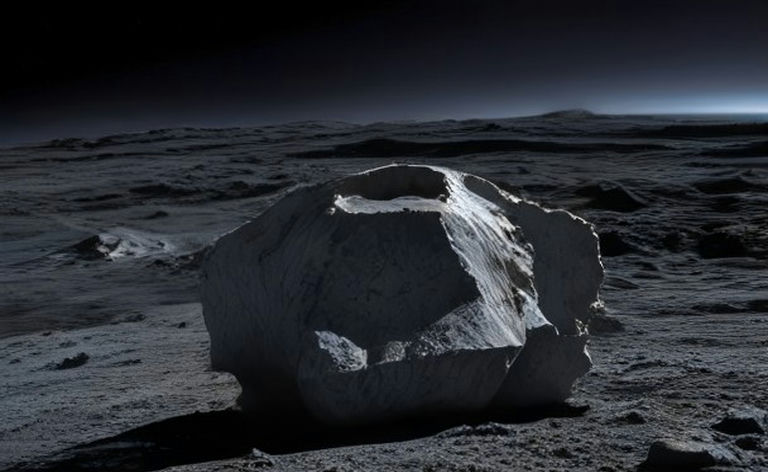
Astronomers and planetary defense researchers have gained critical insights into asteroid impact mechanics after deliberately crashing a spacecraft into a distant asteroid. The resulting images reveal the formation of a massive, stadium-sized crater, providing scientists with vital data necessary for protecting Earth from natural cosmic threats.
The controlled impact, conducted by an international team, was designed to test advanced techniques for simulating planetary defenses without risking actual deep space missions. The study, which utilized specialized remote sensing equipment, successfully documented how celestial bodies react to high-energy impacts at a distance.
The primary finding centers on the formation dynamics of the massive crater. Scientists are analyzing the sheer scale and structural integrity of the resulting depression, which gives them a clearer picture of energy dispersal. This data is crucial for modeling how large-scale impacts affect the geological and chemical composition of asteroids and other minor planets.
“The scale of the crater provides an unprecedented ground truth for our impact models,” stated Dr. Evelyn Reed, a planetary scientist at the Jet Propulsion Laboratory. “Before this, our simulations relied heavily on theoretical physics. Now, we have empirical evidence of how quickly and how widely the shockwaves propagate.”
The research fundamentally shifts the approach to planetary risk management. Historically, defense planning was based on extrapolations from terrestrial geology. This new data allows engineers to design more precise and robust technologies for deflection and mitigation.
The data gathered is directly applicable to developing future deflection strategies. These strategies range from kinetic impactors—sending a spacecraft to strike the asteroid—to more advanced concepts like gravitational tractors. Understanding the crater’s formation helps predict the optimal timing and force required to safely redirect a threatening object.
According to Dr. Kenji Tanaka, Director of the Global Impact Assessment Initiative, the research accelerates the development timeline for global preparedness. “This isn’t just about astrophysics; it’s about global resource protection and risk management,” Dr. Tanaka explained. “By simulating these events, we are building a blueprint for human civilization’s survival playbook.”
The findings necessitate a collaborative effort between aerospace engineers, geologists, and international defense bodies. Future research will focus on applying these impact mechanics models to different types of asteroids, including those with varying densities and compositions.
This breakthrough solidifies the field of planetary defense technology, moving it from theoretical modeling to demonstrable, actionable science. The deep space simulations are not merely academic exercises; they represent a critical advancement in humanity’s capacity to safeguard its future against the unpredictable forces of the cosmos.